
To completely understand resting potential, we need to take a look two basic phenomena in nature: diffusion and electrostatics.
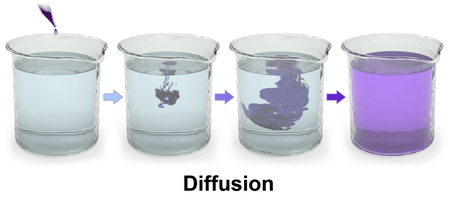
Diffusion is the process by which particles spread out or mix, for instance, in a solution. Take for example a beaker of water. Imagine that you drop a bit of dye into the beaker and wait. After the initial ‘splash’ of the dye falling into the water, the dye spreads out very slowly, usually over the course of hours, before it is uniformly distributed in the water. This gradual spreading is diffusion. The overall movement of the dye is governed by the thermal energy and movement of individual dye molecules. These molecules are bumping into each other at an atomic scale, and the result is a drunken random movement of particles in the solution. When looking at the big picture, the process of diffusion causes particles to move from regions of high concentration to regions of lower concentrations. Even though diffusion is a purely random process, we can think of diffusion as an inexorable force that drives particles down a concentration gradient (high to low). This process is seen in all aspects of biology, and it is essential to life as we know it.
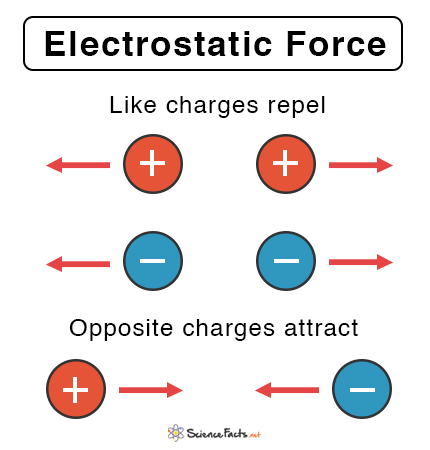
Electrostatic forces are the second key to understanding resting potential. We already alluded to these forces when discussing batteries in the Resting Potential and Voltage Blog, but now, let’s dig a bit deeper into what is going on. All particles have a positive or negative charge associated with them. These charges serve as the basis of electricity. Same charges, such as positive and positive charges (+, +) or negative and negative charges (-,-) repel one another, while opposing charges, such as positive and negative charges (+, -), are attracted to each other.
Simply understanding these two phenomena makes learning about resting potential and the overall function of the neuron a lot easier. In our next blog, we will dive into potentials and equilibrium to take a deeper look at the inner workings of a neuron.
 BioLogically