
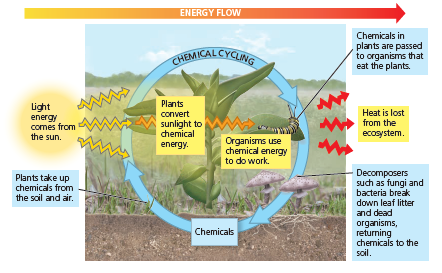
The fundamental characteristic of all living organisms is their use of energy to carry out life’s activities. Moving, growing, reproducing, and other cellular activities all require energy. The input of energy from the sun, and the transformation of that energy from one form to another is what makes life possible. For example, plants absorb energy from the sun through their leaves, but the energy does not stay in the same form. Instead, energy in the form of sunlight is converted to chemical energy for food, such as sugar, during the process of photosynthesis. The chemical energy, in the form of food molecules, is passed along by producers, living things that can make their own food using air, light, soil, and water, such as plants, to consumers. Consumers are the opposite of producers, because they feed on other organisms to get their food and energy. Any type of animal, such as a rat, snake, lion, or platypus, are consumers because they feed on another organism, animal or plant, to get their food and energy.
It is important to remember that an organism can and will lose energy, but that energy does not just vanish. For example, when an organism uses chemical energy to do work, such as muscle contractions, digestion, or cell division, that energy does not just disappear. Instead, chemical energy is lost into the surroundings as heat, a form of thermal energy. We know that energy enters into an ecosystem in the form of sunlight, but we also know that energy exits an ecosystem as heat. This means that energy flows through our ecosystem in one direction. In contrast, chemicals cycle within our ecosystem, as they are used but are then recycled and reused. For example, the chemicals that a plant absorbs from the air or the soil will be absorbed into the plant and will be incorporated in the plant’s body. These chemicals will be passed on to another organism that consumes the plant. Eventually however, these chemicals will be returned to the environment by decomposers, such as fungi and bacteria, that break down organism waste products and the dead bodies of organisms. And as a result of decomposition, chemicals are available in the soil once again to be taken up by plants, therefore completing the cycle of chemicals in an environment. It is crucial to understand that energy flows in one direction in an ecosystem while chemicals are cycled.
Interactions between the components of any system at any level of the biological hierarchy allow for smooth and integrated functioning of the entire system. This holds true for both the functioning of molecules within a cell and the components of an ecosystem, even though a cell and an ecosystem are at very different levels of the biological hierarchy. At the lower levels of organization, specifically those that make up an organism, such as molecules, cells, tissues, organs, and organ systems, the smooth interactions between these components is crucial to the function of the organism. Take for example the regulation of blood sugar levels. In the body, the supply of fuel, in this case, sugar, must match its demand. Cells carry out this process through regulating the opposing processes of sugar breakdown and sugar storage to ensure that the supply and demand of fuel are balanced and in equilibrium. This is made possible due to the ability of many biological processes to self regulate its effects through a system known as feedback.
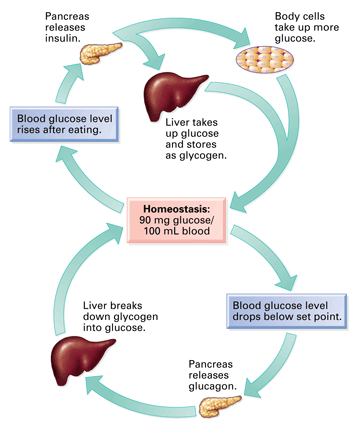
In feedback regulation, the output or result of the process is what actually regulates and controls that very process. The most common form of regulation present in biology is the negative feedback loop, in which the product of the loop works to reduce the initial stimulus. Most homeostatic mechanisms operate on a negative feedback loop, meaning that when there is a stimulus pushing an organism’s internal environment away from its usual level, it triggers something else in the organism’s body to return its internal environment back to a state of normalcy. For instance, the human body always tries to maintain a certain level of glucose in the bloodstream, but this perfect glucose concentration in the blood is disrupted when you consume food. When you eat, the glucose from the food goes into the bloodstream, resulting in the increase in blood sugar levels. The body recognizes this increased concentration of glucose, and it responds by releasing a hormone known as insulin from the pancreas to remove the excess sugar from the blood by signaling the body’s cells to take up and store that excess glucose. The insulin circulating in the bloodstream reduces the blood sugar levels and returns the body internal environment back to normalcy. Once the blood sugar levels are returned to normal, the stimulus for insulin secretion is eliminated and insulin secretion is halted. As we can clearly see in the insulin negative feedback example, the output of the process regulates the function of the process.
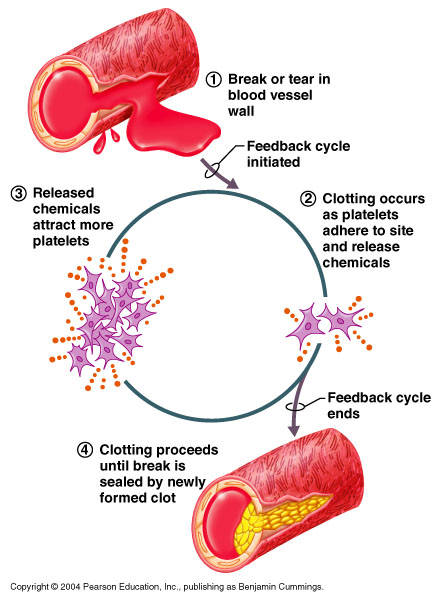
Now, if there is negative feedback, then there is positive feedback as well. Positive feedback loops are less common than negative feedback loops, nevertheless, positive feedback loops are utilized by many biological processes. Instead of reducing the initial stimulus, the product of positive feedback speeds up its own production. The process occurs when a stimulus moves some aspect of an organism’s internal environment from normalcy, and in response to the change, the body employs organs and other structures to enhance and amplify that original stimulus. The clotting of blood in response to an injury is a prime example of positive feedback. When a blood vessel in the body is damaged, a type of blood cell, known as platelets, aggregate at the damaged site. The positive feedback aspect of this situation is initiated when the platelets begin to use chemical signals to attract more platelets to the injury. As more platelets arrive, they begin to pileup and achieve the end goal of this feedback loop, which is to completely seal the wound with a large clot. Since more and more platelets congregate to form a growing blood clot in the area of a wound, the initial stimulus is amplified, making this process a positive feedback loop.
Let us shift gears and talk about ecosystems and the interactions that happen within them. At the ecosystem level, every organism interacts with other organisms. An acacia tree, found in Africa, interacts with the soil microorganisms that are associated with its roots, insects that inhabit it, and animals that use its leaves and fruit as a source of food. The African acacia doesn’t only interact with other organisms, it also interacts with its physical environment. For example, the leaves of the acacia tree absorb light energy from the sun, in addition to taking in carbon dioxide from the air and releasing oxygen as a product of photosynthesis. The leaves will, at some point, fall to the ground, where they will be decomposed by organisms that return the minerals in the leaves back to the soil. Furthermore, when animals eat the leaves and fruits of the tree, they end up returning nutrients and minerals to the soil through their waste. The water and minerals in the soil are also absorbed by the tree’s roots. One organism in an ecosystem interacts with all the other organisms in the ecosystem as well, and it becomes a cycle that will continue on till the end of time.
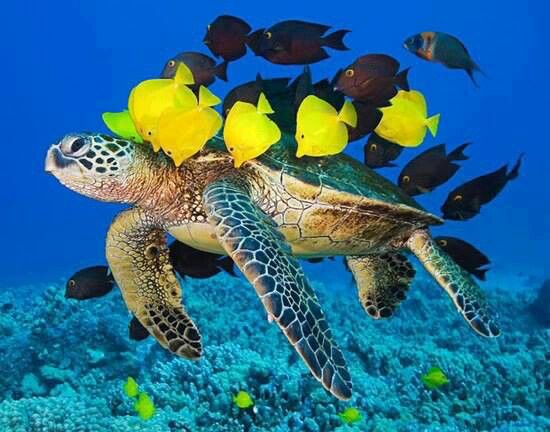
Interactions between organisms can be organized into different categories, such as mutually beneficial, partially beneficial, and mutually harmful. An example of a mutually beneficial relationship would be that of a cleaner fish and turtle. Cleaner fish eat the parasites off of a turtle’s shell, which keeps the turtle’s shell clean but also provides a food source for the cleaner fish. A lion killing and eating a zebra is an example of a partially beneficial relationship where one organism benefits while the other is harmed. The lion benefits by getting food (the zebra0, while the other organism, the zebra, is killed. There are also several relationships in which both organisms can be harmed – for example, when two plants compete for a soil resource that is in short supply, resulting in both plants dying without absorbing an adequate amount of nutrients. Interactions between organisms help to regulate the functioning of an ecosystem as a whole.
Each organism continuously interacts with the physical aspects in its environment. For instance, the leaves of a tree absorb light from the sun and carbon dioxide from the air, and then release oxygen as a product back into the environment. Just like the environment affects organisms, organisms also affect the environment. The roots of a plant not only take up water and nutrients from the soil, but they also break rocks as they grow, contributing to the formation of soil. When looking at the Earth as an ecosystem on a global scale, the plants and other photosynthetic organisms have been responsible for the generation of all the oxygen in the atmosphere.
Humans, like other organisms, also interact and affect the environment. But not all of these interactions are positive, as most of our interactions have had dire consequences on the well being of our environment. A very prevalent negative interaction would be the burning of fossil fuels. Over the past 150 years, humans have significantly increased the burning of fossil fuels (coal, oil, and gas). This practice releases large amounts of carbon dioxide and other greenhouse gases into the atmosphere, trapping the outgoing heat close to the Earth’s surface. The burning of fossil fuels severely affects global temperature, which depends on the balance between incoming sunlight, which warms the Earth, and the outgoing heat to space, which cools the Earth. What makes greenhouse gasses, such as carbon dioxide (CO2), so potent to the Earth and our environment is that they affect the temperature balance by allowing sunlight into the atmosphere to warm up the Earth, but preventing most of the heat from escaping. And when there is more and more heat trapped in the Earth’s atmosphere, over a period of time we see a significant increase in global temperature. In fact, scientists have calculated that the carbon dioxide released into the atmosphere due to human activities has resulted in the average temperature of our planet increasing by two degrees Celsius since 1900. But at the current rate at which greenhouse gasses are being emitted into the Earth’s atmosphere, global models predict an additional rise of three degrees Celsius by the end of the twenty-first century.
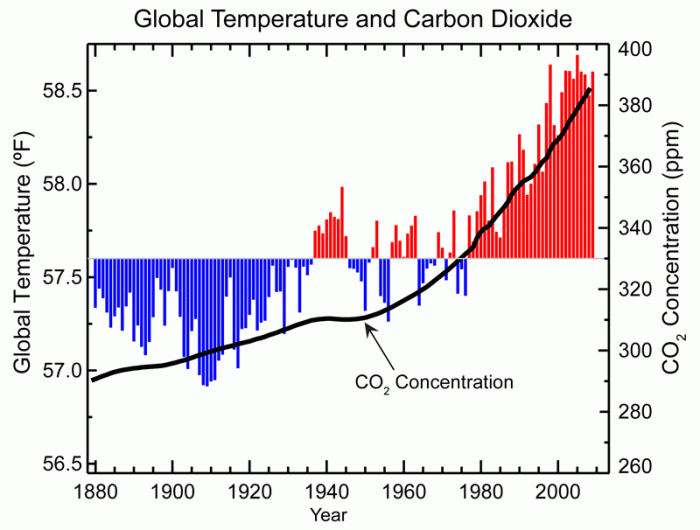
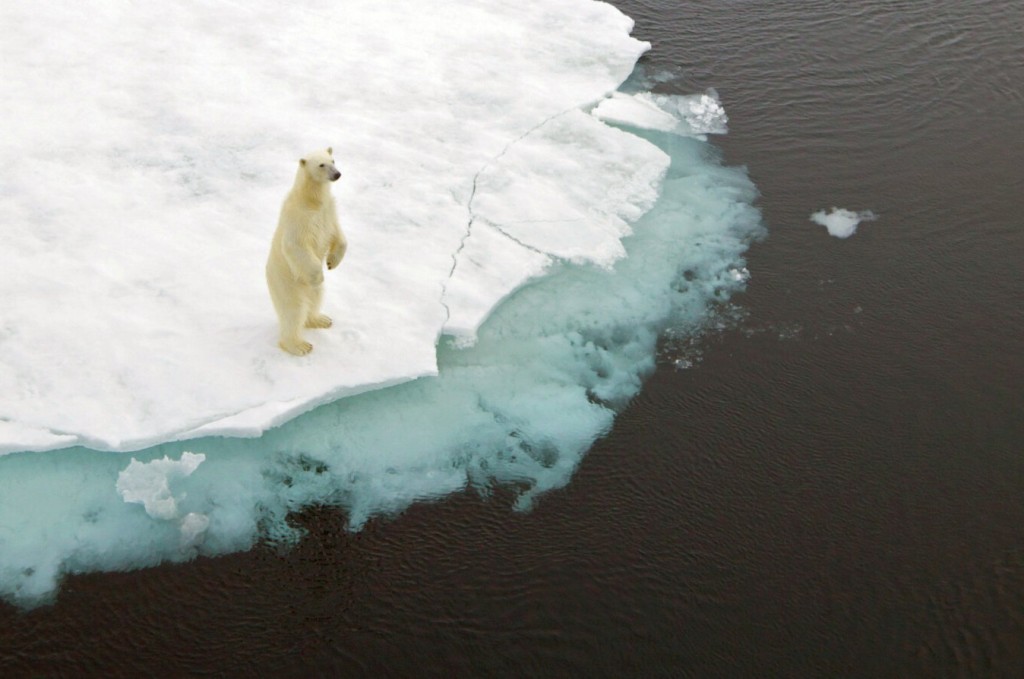
The ongoing global warming is the main aspect of climate change, the long term directional change to the global climate for three decades or more, as opposed to short term weather changes. However, global warming is not the only way that the climate is changing. Wind and precipitation patterns have also been changing, and extreme weather events, such as droughts, are occurring more and more often. Furthermore, climate change has already impacted the lives of organisms and their habitats across the world. Polar bears, for example, have lost most of their ice platforms and habitat due to the increase in temperature. The melting away of their ice platform, which they use to hunt, leads to food shortages and increased mortality rates. As habitats deteriorate, animals and plants are forced to search for and relocate to new locations, but for some, there is no other suitable habitat and others aren’t able to migrate to a new habitat fast enough to survive. As a result of increased global warming and the ongoing loss of habitat, populations of many species are shrinking in size, and even disappearing. This trend in the decrease of a population of a species can and usually will result in extinction, which is the complete loss of a species.
Now, having understood the four unifying themes of biology- information, organization, energy and matter, and interactions- in our next basic biology blog, we will discuss a core theme of biology, evolution.
 BioLogically