
Have you ever considered explanations for why the Earth is spherical or why there are so many animals in the world? You might propose a “theory” to explain these phenomena or the nature of existence itself. However, your use of the word “theory” is incorrect. In society, the word “theory” often implies speculation or hypothesis. However, its meaning in science differs significantly. There are three main distinctions to be aware of:
- Broader in scope – Scientific theories encompass a broader scope than hypotheses. Hypotheses must be highly specific because they undergo experimental testing. For instance, a hypothesis might propose that various beak shapes in birds within different habitats enhance their ability to obtain food and survive. In contrast, a theory on the same subject would posit that adaptations observed in evolution are outcomes of natural selection. This overarching theory suggests that natural selection is the mechanism driving evolution, resulting in diverse adaptations. The hypothesis, on the other hand, focuses on a singular case of an evolutionary adaptation due to natural selection in distinct environments.
- General phrasing – Due to the broad scope of theories, their formulation should be general enough to allow for the development of multiple hypotheses. Building on the example of the theory of natural selection mentioned earlier, another hypothesis that can be derived from it, besides the bird beak example, is that the fur color of mice matching the general color of their environment is an evolutionary adaptation. This adaptation could protect mice from predators through camouflage, thereby enhancing their survival.
- Supported by more evidence – Unlike hypotheses, a statement must be supported by a substantial body of evidence to be considered a theory. For example, numerous experiments and scientific data have consistently supported the theory of natural selection, with none contradicting it, firmly establishing it as a widely accepted scientific theory. Theories serve scientists by explaining various observations and evidence, and in turn, the evidence reinforces the theory’s validity.
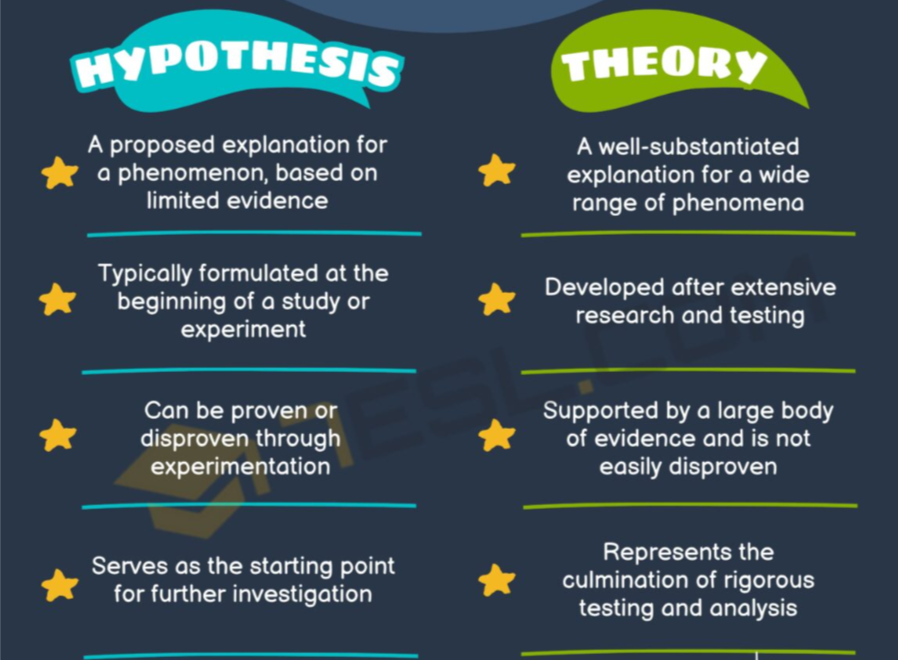
However, it’s crucial to acknowledge that while theories are generally accepted by the scientific community when backed by evidence, they can be rejected or invalidated if new scientific evidence contradicts them. A notable example is the classification of kingdoms in biology. Bacteria and archaea were initially grouped together in the prokaryote kingdom. However, advancements in scientific technology allowed researchers to explore the relationship between bacteria and archaea more deeply. The resulting evidence refuted the theory that both bacteria and archaea were prokaryotes, leading to the revision of this statement’s classification as a theory. Ultimately, what is considered scientific truth depends entirely on the current body of available evidence. In our upcoming Basic Biology blog, we will explore how diverse scientific perspectives contribute to the collaborative nature of science!
 BioLogically