
Operant conditioning, a form of associative learning, centers on the consequences that follow our actions and how they influence the likelihood of those behaviors recurring. To comprehend operant conditioning, several key terms need clarification. Firstly, a stimulus, also known as an antecedent, precedes the behavior and typically triggers it. The behavior itself is the response to this stimulus. Subsequently, the consequence of the behavior, whether it reinforces or diminishes it, affects its future occurrence. Conceptualizing operant conditioning, we see it as a learning framework where individuals engage in actions that elicit consequences. Each action is followed by a consequence, and this shapes future behavior. Consider a child studying diligently for an exam and achieving high marks. In response, the parents reward the child with a celebratory ice cream outing, reinforcing the studying behavior. This positive reinforcement encourages the child to continue studying diligently. Conversely, negative behavior, like talking back to parents, results in adverse consequences such as reprimands and loss of privileges, discouraging its recurrence. These examples underscore that behaviors are voluntary and influenced by their consequences. Referred to as operants, these behaviors are chosen freely by individuals, with their likelihood of recurrence contingent upon present consequences.
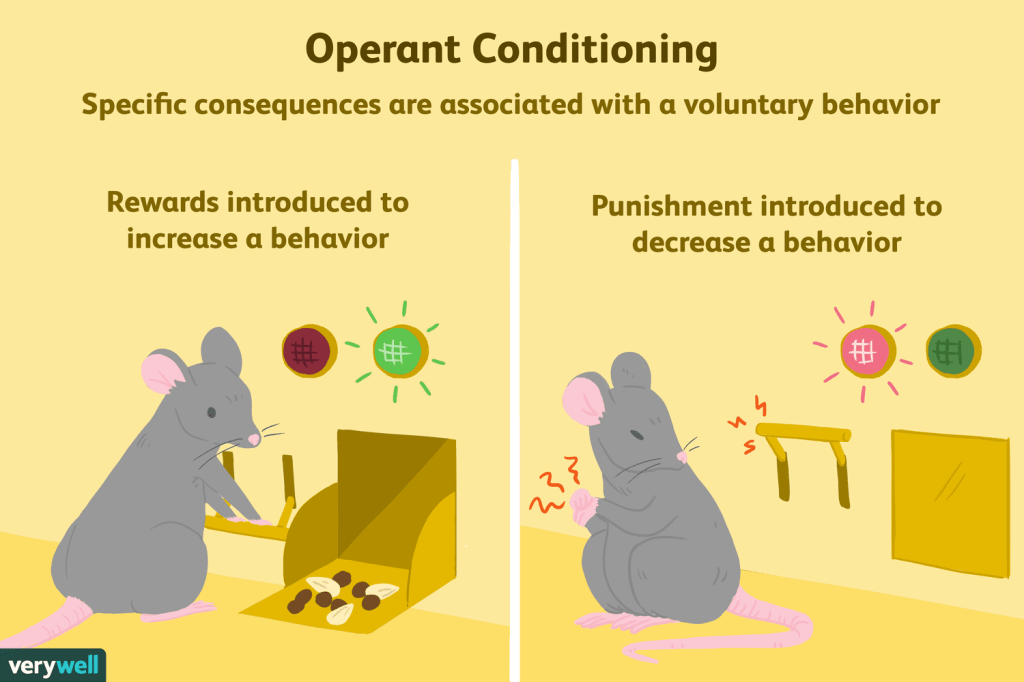
So, what underlies the premise of operant conditioning? It’s the idea that based on the consequences of our actions, we become more or less inclined to repeat those actions. Central to understanding operant conditioning is the concept of contingency, where one event follows another. Operant conditioning operates akin to an “If-Then” statement: “If I do X, then Y will happen.” In this context, it means that if a specific behavior is performed, then a particular consequence will follow. Crucially, these events—the response and the consequence—are temporally linked.
Consequences in operant conditioning manifest in two main forms: reinforcement and punishment. Reinforcement increases the likelihood of a behavior recurring in the future, thus strengthening and encouraging it. Conversely, punishment decreases the likelihood of a behavior happening again, weakening it. Both reinforcement and punishment can be categorized further into two types: positive and negative. It’s crucial to note that these terms lack inherent emotional connotations; they simply denote the addition or removal of something. “Positive” signifies the addition of a stimulus, regardless of whether it’s perceived as good or bad, while “negative” indicates the removal of a stimulus, again without regard to its emotional valence.
Consider this: giving something, regardless of its nature, is classified as positive. When you offer something aversive or undesirable to weaken a behavior, it constitutes positive punishment. Conversely, when you provide something desirable to reinforce a behavior, it falls under positive reinforcement. Now, if you remove something unpleasant, thereby bolstering the likelihood of desirable behavior, it qualifies as negative reinforcement. However, if you take away something favorable, diminishing the likelihood of the behavior, it is categorized as negative punishment.
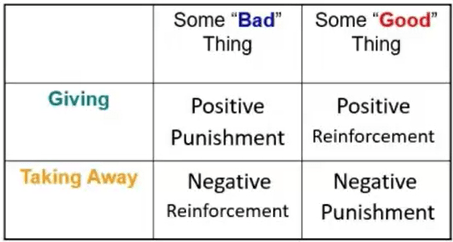
When something aversive or undesirable is introduced or added, diminishing the likelihood of a behavior in the future, it constitutes positive punishment. Consider a scenario where talking back to your mother results in her smacking you; this act of aggression serves as positive punishment, as the aversive consequence of the slap is added following your behavior of talking back in attempt to decrease that behavior. On the flip side, positive reinforcement entails increasing the probability of a behavior occurring in the future by introducing or adding something desirable. For instance, achieving an A on an exam after studying diligently serves as positive reinforcement, as it encourages future studying behavior. Negative reinforcement involves the removal or subtraction of something unpleasant due to your actions, thereby increasing the likelihood of repeating the behavior in the future when faced with similar stimuli. For instance, taking Tylenol to alleviate a headache results in the removal of pain. This reinforces the behavior of taking Tylenol when experiencing headaches. Furthermore, negative reinforcement can lead to either immediate escape behavior or future avoidance behavior. Consider the act of taking a shower to remove a bad smell; the removal of the unpleasant odor serves as negative reinforcement, reinforcing the behavior of showering to maintain pleasant hygiene. Finally, negative punishment entails the removal or subtraction of something desirable, thereby decreasing the likelihood of that behavior occurring in the future. For example, being deducted 20 points from your final grade for arriving late to class serves as negative punishment, as the removal of the points (an undesirable outcome) decreases the likelihood of future tardiness.
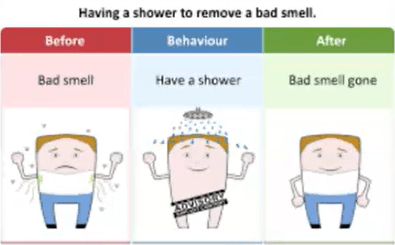

Escape behavior, a pivotal concept in understanding negative reinforcement, occurs when we are currently enduring an aversive situation and want to terminate it. When engaging in a behavior results in the cessation of the aversive event, such as alleviating withdrawal symptoms by consuming coffee after abstaining from caffeine for a period, we can consider this as successfully escaping the aversive state. Similarly, eating food to relieve hunger represents another form of escape behavior, as it alleviates the discomfort of hunger. On the other hand, avoidance behavior goes a step beyond escape behavior. Consider the action of taking Tylenol to alleviate a headache. To avoid the onset of headache symptoms altogether, one might consume coffee regularly throughout the day. This proactive strategy is termed avoidance behavior. By adopting this approach, individuals effectively eliminate the possibility of encountering the aversive event, which also indicates that learning has taken place. Drawing from past experiences, individuals identify the triggers for headaches and take preemptive measures to avoid them. Similarly, consuming small meals throughout the day to prevent hunger pangs exemplifies avoidance behavior.
Now that we have discussed the 4 different types of reinforcements and punishments, we can create a streamlined way to determine whether we are working with something positive or negative.
- If something is positive, you will see words indicating that something was given, earned, or received.
- If something is negative, you will see words indicating that something was taken away or removed.
When trying to identify whether a behavior is being reinforcement or punished, you can follow these tips:
- If a behavior is being reinforced, you will see a clear indication that the behavior increases in the future.
- If a behavior is being punished, there will be an indication that the behavior decreases in the future.
ChatGPT
Consider another scenario: you devote significant effort to studying for your calculus exam and achieve an A grade. In response, your parents reward you with $200, which increases enhances the likelihood of you studying diligently in the future to attain further rewards for academic excellence. To analyze this scenario effectively, we must first discern whether the situation entails a positive or negative context, and subsequently ascertain whether it involves reinforcement or punishment.
- Positive or Negative – “Your parents give you $200” and you “earn an A” – This means that you are given both an A and money, suggesting that this situation is a “positive” something.
- Reinforce or Punish – “In the future, you study more diligently” – This means that by giving something, you seek to increase behavior, and this is a reinforcement.
- Together – this situation highlights positive reinforcement.
Beyond simply identifying the type of reinforcement or punishment at play, it’s imperative to recognize the magnitude of the reinforcer or punisher, indicating the degree of influence it wields over behavior. Consider this: would you be more motivated to strive for an A grade if rewarded with $100 per achievement or $10 per achievement? The likelihood is that the $100 reward would be more enticing, as it offers a greater benefit. Similarly, the severity of consequences can significantly impact behavior. For instance, homicide carries more severe repercussions, such as life imprisonment or even the death penalty, compared to lesser crimes like petty theft where the penalties are a maximum of a 10-year sentence with the possibility of parole. This underscores why society imposes harsher penalties for homicide than for minor offenses. This aspect of operant conditioning, known as magnitude, refers to the measure of how substantial a reinforcer or punisher is, and it undeniably influences behavior. Therefore, society must ensure that the magnitude of reinforcement or punishment aligns with the gravity of the behavior in question.

When evaluating the effectiveness of positive or negative reinforcement or punishment, it’s crucial to acknowledge individual differences. People are inherently diverse, each with unique motivations and preferences. While reinforcers universally influence behavior, not all individuals will respond to the same reinforcers in the same manner due to these individual distinctions. Nevertheless, positive and negative reinforcements, as well as punishments, exert substantial influence in shaping our daily behaviors. In our next Biopsychology blog, we will explore what creates one’s identity!
 BioLogically