The idea of learning is integral to our everyday lives as human beings. Children are enrolled in pre-school and the k-12 education system to learn new information and proper behavior. Adults in their field of work learn new practices or technological skills. Given the importance of learning in life, it is crucial to understand and define the innerworkings of the learning process. To start off, learning is any permanent change in behavior as a result of practice or experience, but changes due to growth or maturation are not considered to be learning. Researchers have determine that learning is stimulated through rewards (known as operant conditioning), punishments, and classical conditioning.
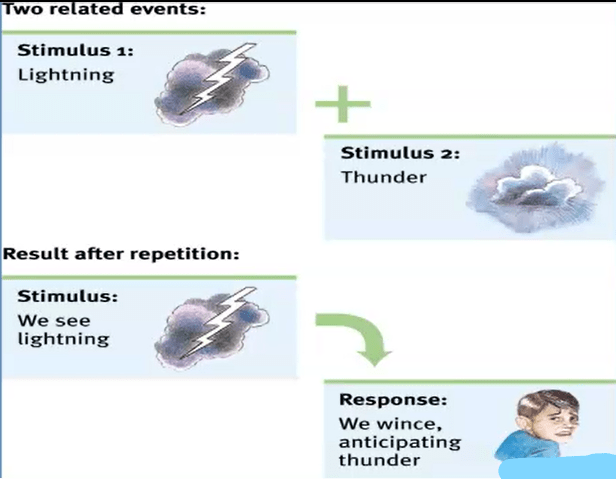
Let’s now dive deeper into classical conditioning! Through classical conditioning, people and animals can acquire certain behaviors. This is a learning process in which associations are made between an unconditioned stimulus and a neutral stimulus. To understand what this means, we need to define 6 key terms. A stimuli is something that elicits a response. A neutral stimulus (NS) is something that initially does not elicit a response. An unconditioned stimulus (UCS) is something that elicits a predictable or natural response without training. Similarly, an unconditioned response (UCR) is the automatic or natural reaction to a stimulus without training. For instance, if you hear a loud noise, you will jump. The loud noise is the UCS while you jumping is the UCR. On the other hand, a conditioned stimulus (CS) is something that elicits a response due to being paired with and presented with a UCS while a conditioned response (CR) is the learned reaction to that specific conditioned stimulus. A good example of the connection between the UCS and CS is seen with lightning and thunder. Thunder is the UCS which elicits the response of an individual covering their ears when they hear it, which is the UCR. If we pair the thunder with the second stimulus of lighting, which will present itself before thunder, initially, an individual will continue to cover their ears not when they see the lightning but when they hear the thunder afterwards. So if we go back to our definitions, lightning is initially a NS. If we repeatedly present lightning and then thunder several times to an individual, after this repetition, if that individual sees lightning, they will automatically cover their ears, even before they hear the thunder, because they have learned the association between the two stimuli. After this repetition, lightning has become a CS and the covering of the ears has become a CR. This idea suggests that a response can become conditioned with the repetitive pairing of a UCS with another stimulus, which becomes a CS through repetition.
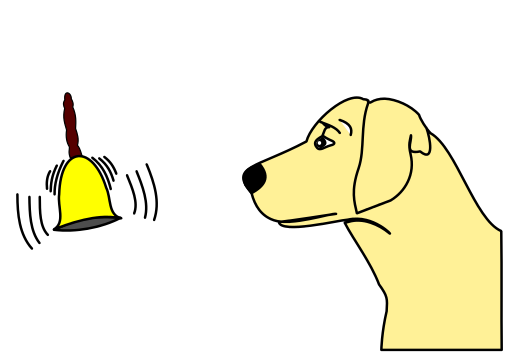
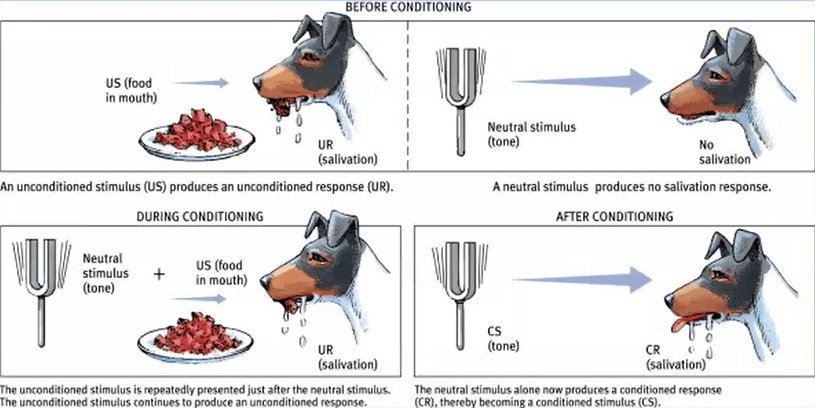
The most famous classical conditioning experiment was conducted by Ivan Pavlov, with the subject of most of his experiments being dogs. In Pavlov’s Dogs Experiment, the UCS was food and the UCR was the dogs salivating. Pavlov paired the UCS of food with a neutral stimulus, which was the ringing of a bell, and he was able to train the dogs to have conditioned responses. During this experimentation, Pavlov initially gave the dogs food and then would ring the bell. At the presentation of food, the dogs would salivate. Through repetitive pairing and presentation of the food and bell, the dogs became trained to salivate at just the sound of the bell, even when food wasn’t presented. So, after repetition, the CS is the bell and the CR is the dogs salivating at the sound of the bell. Pavlov essentially trained the dogs to express the same response they had to food but, now, at the sound of a bell.
A common example of classical conditioning is seen with the usage of electrical wires to keep cows in a field. In this situation, the UCS is the electric shock to the cow while the UCR is the cows response to jump away from the fence. Through the cow repeatedly getting close to the fence and trying to escape, the cow learns the association between the electric shock and the wire fence. Therefore, the CS is the wire, and anytime the cow sees a wire, it has the CR of staying away. Another example is seen with cats and can openers. Cat food frequently come in cans, so to feed their cat, the owner needs to open the canned food with a can opener. Normally, when a cat sees food (UCS), it runs into the kitchen (UCR) to eat it. Through repetitive usage of the can opener to open the food, the cat learns that the when they see their owner with the can opener, it means that food is on its way. Therefore, the CS is the can opener and the cat’s CR is running into the kitchen. This also means that anytime the owner uses the can opener, even if it isn’t for getting their cat’s food, the cat will run into the kitchen at the sight of the can opener in their owner’s hand.
One of the more disturbing instances of classical conditioning experiments is the Little Albert Experiment conducted by John B. Watson. Watson’s goals was understand how classical conditioning can be utilized in humans. So, Watson conducted several experiments on a child, called Little Albert, and the most successful experiment was when he utilized the stimulus of a loud noise paired with the presence of a white rat to elicit fear in the baby. Typically, when a baby hears a loud noise (UCS), they get startled and start crying (UCR). Watson linked the UCS of a loud noise with the stimulus of a white rat (NS). By repeatedly presenting the loud noise with the presence of the white rat, Watson elicited a fear response and crying from Little Albert just with the presence of the white rat. This resulted in the white rat being the CS and the fear/crying being the CR. What took this experiment a step further is that Albert saw similarities between a white rat and other small white animals. Therefore, the presentation of a bunny or stuffed animal also elicited the same fear and crying response from Little Albert.
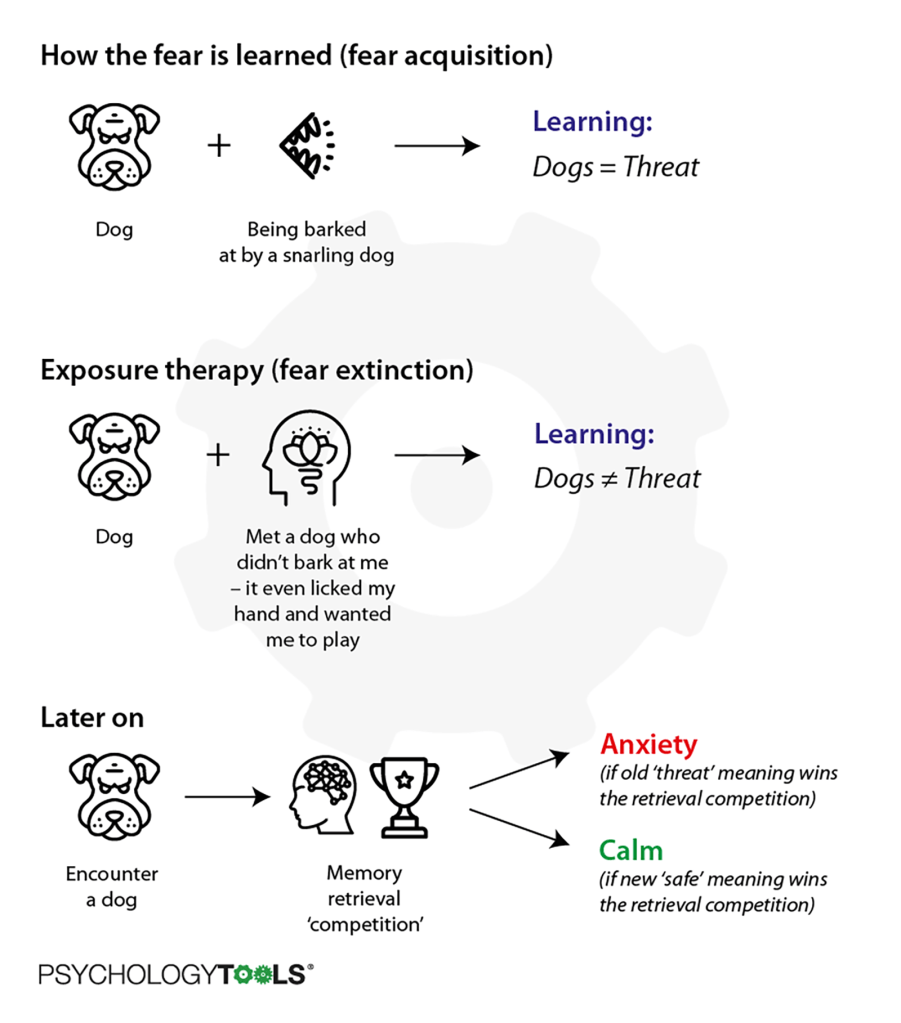
To better understand the consequences of classical conditioning, we need to define 4 key terms. Generalization is responding to a second stimulus in a similar manner to the original CS. This is exactly what happened in the Little Albert case when Albert began generalizing his fear response to small white things similar to a rat, such as a rabbit. Discrimination is the ability to response differently to different stimuli. Extinction is the process of the CR gradually dying out after the CS is repeatedly presented without the UCS. This is what you want to see in fear classical conditioning experiments so that the test subjects can regain their mental composure. Spontaneous recovery is the process of when the CR reappears after a period of rest following extinction.
There are several practice and useful applications of classical conditioning. This includes treatment of phobia, such as immersion therapy, behavioral elimination, counteracting existing conditioning (tends to be existing negative behavior), and advertising. Classical conditioning is also seen in school systems. When the bell rings to indicate the end of a class period, students are classically conditioning to transition to their next classroom at the sound of the bell. An interesting discussion would be evaluate the number of things in your life that you have been classically conditioned to. It’s pretty amazing how frequently classical conditioning is utilized to maintain order and organization within society, even without our conscious knowledge. In our next Biopsychology blog post, we will discuss another learning process called operant conditioning!
 BioLogically