
Biopsychology is a branch of psychology that deals specifically with how the brain and neurotransmitters act upon the body, influencing what we do, say, and feel. In other words, it is the biology of the mind. This field leans heavily on neuroscience and includes the study of the nervous system. Anatomy, physiology, and statistics are also essential in the study of biopsychology.
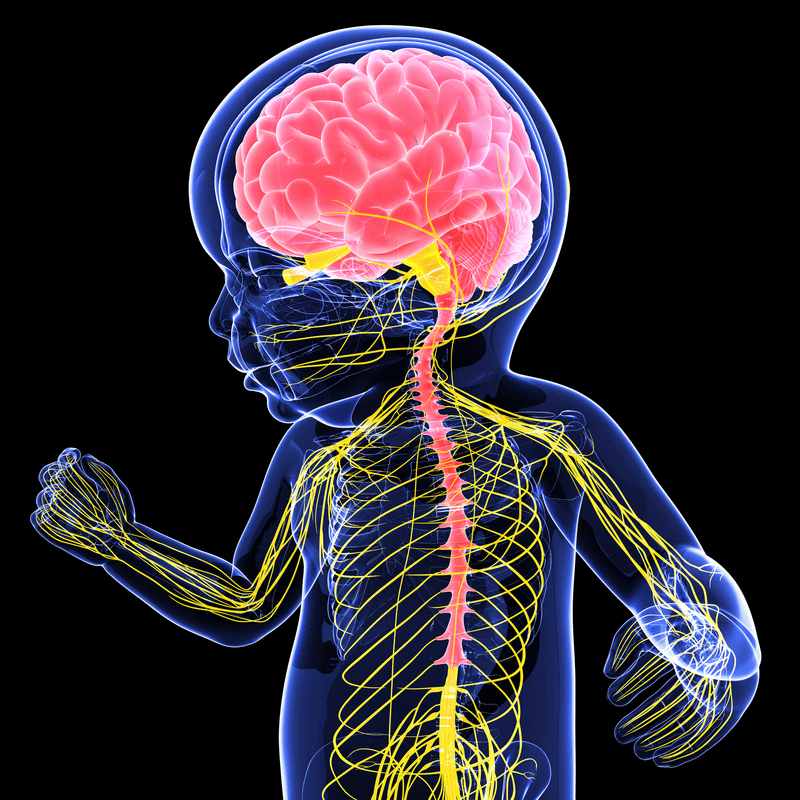
Understanding the nervous system is the key to learning biopsychology, which means we have to dive into neural communication, the process by which we send neural signals to and from all parts of the body to the brain. Examples of neural communication are when we raise our hands to stretch or look out a window to see what is happening outside.
Neural communication is possible because the body’s information system is built from billions of interconnected cells called neurons. A neuron, also known as a nerve cell, consists of many different parts.
- Soma (cell body): the life support center of the neuron which also sends out signals and communication that tells the neuron what its job is
- Dendrites: branching extensions of a neuron’s cell body that receive messages from other neurons
- Axon: long single extension of a neuron, covered with a myelin sheath to insulate and speed up messages through the nervous system
- Terminal branches: branches of the axon that transmit messages to other neurons and form junctions with other cells

In order to understand how neural messages are transmitted, we need to cover a couple of neurology related terms. The term threshold refers to the limit of excitatory and inhibitory signals each neuron receives. Excitatory signals from a sending neuron spark the propagation of an action potential in the receiving neuron, while inhibitory signals cancel the action potential. When the excitatory signals minus the inhibitory signals exceed a minimum intensity, the threshold, the neuron fires an action potential. In other words, when the excitatory signals are greater than the inhibitory signals, the neuron fires an action potential, which is how neurons communicate.
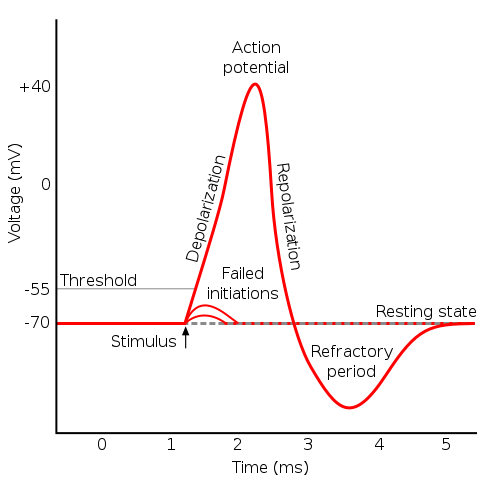
An action potential is a neural impulse, which is a brief electrical charge that travels down an axon and is generated by the movement of positively charged atoms, ions, in and out of the channels in the axon’s membrane. The differences in concentration between the positively and negatively charged atoms entering and exiting the cell help to transmit the electrical and chemical signals throughout the body.
The two main things that we need to learn about when covering action potentials are all or none responses, and intensity levels. An all or none response refers to how a strong stimulus can trigger more neurons to fire, and fire more frequently, but it does not affect the action potential’s strength or speed. This means that an action potential will either occur or not occur.
The intensity of an action potential remains the same throughout the length of the axon. So, it doesn’t matter if the message is strong or weak, it will be sent from the beginning to the end, with the intensity staying the same. Now the question is, how frequently will the neural message be sent. A strong stimulus means more frequently firing neurons, which leads to more messages being sent. On the other hand, a weaker stimulus means less frequently firing neurons, so fewer messages will be sent.
So how do we actually send that signal or message to another neuron? Neurons send signals and communicate through a structure called a synapse. A synapse is a junction between the axon tip of the sending neuron and the dendrite/cell body of the receiving neuron. The tiny gap between the presynaptic and postsynaptic neurons is called the synaptic cleft. It is important to understand that electrical signals cannot be sent across a synaptic cleft, only chemical signals in the form of neurotransmitters can be sent instead.
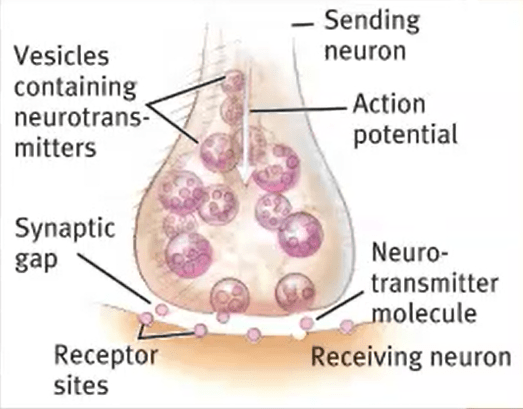
Neurotransmitters are chemicals released from the sending neuron that travel across the synapse and bind to the receptor sites on the receiving neuron, thereby influencing the neuron to generate an action potential. So if the signal received from the neurotransmitters is strong enough, it’s going to initiate an action potential and continue transmitting that message. If the signal isn’t strong enough, an action potential will not be initiated.
It is important to understand that the electrical signals traveling through the neurons are converted into chemical signals, the neurotransmitters, right at the end of the sending/presynaptic neuron before the synaptic cleft. Once the neurotransmitters bind the receptors of the receiving/postsynaptic neuron and trigger an action potential, the chemical signals are once again converted back into electrical signals.

How does our body stop sending a signal? The answer is a process we call reuptake. Reuptake is when neurotransmitters in the synapse are reabsorbed into the sending neurons. This process applies the brakes on neurotransmitter action.
Biopsychology is truly a revolutionary field that is gaining popularity in recent decades, so learning more about it is so interesting. Discussing the nervous system and cell function is just the first step in learning about this incredible field. In the next blog, we will go more in-depth while continuing to discuss the nervous system and its components.
 BioLogically